Choosing the right Professional Lighting System can transform a workplace, studio, venue, or retail space. It affects visibility, atmosphere, energy use, and daily comfort. A bright showroom needs different equipment from a quiet photography studio. The room changes.
This guide explores ten professional lighting system types worth considering before you buy. It covers LED panels, fresnel lights, spotlights, track lighting, high-bay fixtures, softboxes, moving-head units, fiber-optic systems, architectural lighting, and smart-controlled solutions. Each option has practical strengths and limitations. Some provide precise beam control, while others deliver broad, shadow-friendly illumination. Color temperature, CRI, lumen output, dimming performance, mounting options, and heat management all deserve careful attention. Details matter.
Real-world use often reveals issues that product descriptions overlook. A fixture may look powerful online but create harsh glare across a reflective worktable. A compact unit may save space yet offer limited adjustment range. I have found that cable access, replacement parts, fan noise, and control compatibility can influence satisfaction more than appearance. That is easy to underestimate. Buyers should compare verified specifications, manufacturer support, warranty coverage, and relevant electrical safety requirements. Professional installation may also be necessary for permanently mounted systems. No single solution fits every project. Budget, ceiling height, operating hours, maintenance access, and creative goals must guide the decision. This overview aims to make those choices clearer, while acknowledging that lighting plans sometimes need testing and revision on site.
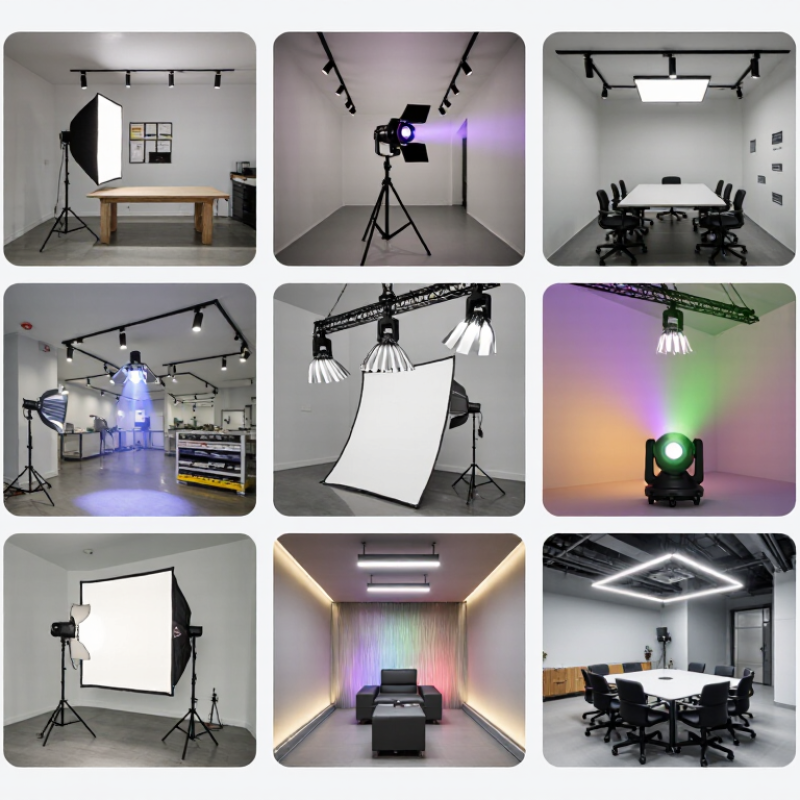
A professional lighting system is a coordinated setup that controls illumination, color, direction, and timing. It is more than a collection of lamps. It combines fixtures, power distribution, control consoles, mounting hardware, sensors, and structured cabling. Control matters. Common system types include stage, studio, broadcast, film, architectural, retail, museum, industrial, event, and outdoor lighting systems.
Each system has a practical structure. Fixtures create the light, while lenses and reflectors shape its beam. Dimmers or drivers regulate output and electrical stability. Control networks send commands to individual fixtures or lighting zones. Sensors can adjust brightness when daylight or occupancy changes. A reliable design also considers heat, ventilation, access, load capacity, and emergency operation.
The core functions are visibility, atmosphere, visual focus, color management, and energy control. In a studio, soft light can reduce harsh facial shadows. In a warehouse, even illumination can support safer movement and inspection. Professional installers measure lux levels, test color consistency, and check glare from normal viewing positions. Qualified electrical work should follow applicable local codes and inspection requirements. Good planning reduces maintenance, but no design is perfect. A powerful system may still feel uncomfortable if glare is ignored. Field testing remains essential, because drawings rarely show every reflection, shadow, or inconvenient control location.
Professional lighting begins with the task, not the fixture. The ten major types include theatrical, film, broadcast, concert, event, architectural, museum, photography, healthcare, and industrial lighting systems. Theatrical systems need controlled beams and smooth dimming. Film and broadcast systems demand quiet operation, stable color, and flicker-free output. Concert and event systems prioritize movement, brightness, and fast programming. Architectural lighting shapes buildings, while museum systems protect sensitive objects. Photography systems require accurate skin tones. Healthcare lighting supports visual comfort. Industrial systems emphasize durability and wide coverage.
The International Energy Agency reports that lighting uses about 15% of global electricity. This makes efficiency a practical buying issue, not merely a marketing claim. Look for measured efficacy, color-rendering data, glare control, and service life. A system may appear powerful yet produce uncomfortable shadows. That is a common purchasing mistake. Controls also matter. Wired networks, wireless control, occupancy sensors, and daylight response can reduce wasted output. Still, complicated control systems sometimes create training problems for small crews.
Tips: Test the system in the actual space. Compare skin tones, reflective surfaces, and dimming behavior. Request photometric files and independent test reports. Check heat, fan noise, maintenance access, and replacement costs. Do not trust one impressive demonstration. A darker room can hide uneven coverage. Local electrical requirements should also be reviewed by a qualified professional.
Professional lighting systems differ most in output, beam control, color accuracy, and heat management.
LED panels provide broad, soft illumination for interviews and small studios. COB fixtures create intense, directional light, while Fresnel lights offer adjustable beams for stage work.
Profile lights project sharp shapes and gobos. Tube lights add flexible, linear coverage.
Moving heads, followspots, strobes, and practical fixtures serve more specialized production needs.
Check measured output, not only advertised wattage. Lux at a stated distance reveals usable brightness. Beam angle affects coverage, spill, and shadow edges.
For accurate skin tones, compare CRI and TLCI results across the full color range. Flicker performance matters for slow-motion cameras. Dimming should remain smooth at low levels.
Fan noise, fixture weight, mounting options, and power draw also influence real-world performance. A powerful light can still be inconvenient if it overheats or needs constant repositioning.
Tips: Test the fixture at your working distance. Read independent photometric reports when available. Compare color consistency at different brightness levels.
My own early setup relied too heavily on wattage, and that caused harsh shadows. I would now inspect diffusion quality first.
Keep a spare control cable and check connector security before every shoot.
Specifications can look impressive on paper, yet a noisy fan or unstable dimming may ruin a quiet recording.
Test before buying.
Professional lighting choices should follow the environment, task, and safety standard. A television studio may need soft LED panels, Fresnel fixtures, and adjustable key lights for controlled skin tones. A theater often combines profile spotlights, moving fixtures, and wash lights for layered scenes. Museums require low-heat, dimmable systems that protect sensitive materials. These applications demand different beam angles, color accuracy, and control methods.
Industrial sites usually depend on high-bay lights, linear fixtures, floodlights, and explosion-resistant systems where regulations require them. Retail spaces may use track lights and accent fixtures to guide attention without harsh glare. Hospitals need examination lights, surgical systems, and low-glare corridor lighting. Offices benefit from recessed panels, task lights, and daylight-responsive controls.
The U.S. Department of Energy reports that LED systems can use at least 75% less energy than incandescent lighting and last up to 25 times longer.
Outdoor environments introduce weather, maintenance, and visibility concerns. Streetlights, area lights, landscape fixtures, and emergency systems must withstand moisture and temperature changes. The International Energy Agency estimates that lighting consumes about 15% of global electricity, so efficiency affects both operating costs and environmental performance.
Still, efficiency alone is not enough. I have seen bright installations create uncomfortable glare and poor contrast. A careful site test may reveal flaws that a specification sheet misses. The best purchase is not always the brightest one.
Choosing a professional lighting system starts with the space, not the fixture. Define task lighting, ambient coverage, color requirements, control methods, and operating hours. A retail display needs accurate color, while a workshop needs glare control and durable housings. Offices may benefit from linear systems, panels, or adjustable track heads. Outdoor areas require weather-rated equipment and safe cable routes. Measure mounting height, ceiling structure, circuit capacity, and emergency access before ordering. Measure twice. A rushed estimate can create expensive shadows.
Installation should follow a documented electrical plan and local safety rules. A qualified electrician should verify load calculations, grounding, protection devices, and isolation procedures. Mark every mounting point on site. Check beam angles from normal viewing positions, not only from a ladder. Keep drivers accessible for service, while protecting them from heat and moisture. I have seen attractive layouts fail because controls were placed where staff could not reach them. The drawing looked right. The room did not.
Create a maintenance log with installation dates, operating hours, cleaning intervals, and fault notes. Dust lenses with suitable materials, inspect connectors, and test dimming controls regularly. Replace damaged cables immediately. Do not ignore flicker; it may indicate a failing driver, loose connection, or incompatible control gear. Review light levels after furniture or equipment changes. A system can remain functional yet become uncomfortable. Annual professional inspection is sensible for complex installations, although smaller systems may need a different schedule. Record every change, even when it seems minor.
| Lighting System Type | Best Applications | Typical Light Source | Common Color Temperature | Key Selection Criteria | Installation Guidance | Maintenance Requirements | Typical Service Life | Energy and Control Features |
|---|---|---|---|---|---|---|---|---|
| LED Panel Lighting | Offices, classrooms, healthcare areas, retail spaces, and suspended ceilings | Integrated LED array with a diffuse lens | 3500–5000 K |
|
Fit the panel securely into the ceiling grid or surface-mount frame. Provide an accessible driver location and follow the required wiring and emergency-circuit rules. | Clean the diffuser periodically with a soft, dry or slightly damp cloth. Check connectors and replace the driver or complete panel if performance declines. | Approximately 50,000–100,000 operating hours, depending on thermal conditions and product quality | High efficacy, occupancy sensors, daylight dimming, 0–10 V dimming, and networked controls may be available |
| Linear LED Lighting | Open offices, corridors, warehouses, retail displays, and continuous architectural lighting | Linear LED modules or LED strips in an aluminum housing | 3000–5000 K |
|
Plan mounting points, suspension cables, joins, and power-feed locations before installation. Keep long runs level and allow ventilation around the housing. | Dust the housing and lens, inspect suspension hardware, and check connections at joins. Replace damaged lenses and failed modules promptly. | Approximately 50,000–100,000 operating hours | Efficient continuous illumination, zoning, occupancy control, daylight harvesting, and tunable-white options may be supported |
| High-Bay Lighting | Warehouses, manufacturing facilities, sports halls, distribution centers, and high-ceiling work areas | High-output LED fixture, often with a heat sink and reflector or lens | 4000–5000 K |
|
Use approved suspension, chain, conduit, or pendant hardware. Secure all fixtures against vibration and keep the driver within its rated temperature range. | Schedule high-level cleaning, inspect mounting hardware, and test controls. Remove dust and debris that could restrict heat dissipation. | Approximately 50,000–100,000 operating hours | Lower energy use than many legacy high-intensity discharge systems; occupancy sensors and aisle controls can reduce operating hours |
| Low-Bay Lighting | Workshops, garages, service areas, storage rooms, and spaces with lower ceilings | LED fixture with a wide or medium distribution | 3500–5000 K |
|
Mount at the calculated height and spacing, avoiding direct line-of-sight glare. Use suitable junction boxes and strain relief for suspended installations. | Clean lenses and reflectors, tighten mounting points, and inspect seals and wiring during scheduled facility maintenance. | Approximately 50,000–100,000 operating hours | Efficient LED operation, occupancy sensing, dimming, and task-based zoning are commonly used |
| Troffer Lighting | Commercial offices, schools, hospitals, and modular ceiling systems | Recessed LED troffer or retrofit LED kit | 3500–4000 K |
|
Support the unit independently where required by local safety rules. Verify ceiling-grid alignment, driver access, and emergency-lighting connections. | Vacuum or wipe the lens and inspect the ceiling grid, wiring, and driver. Replace discolored lenses or degraded components. | Approximately 50,000–100,000 operating hours for LED versions | Can provide reduced energy consumption, low-glare optics, occupancy sensors, daylight response, and dimming |
| Outdoor Area and Flood Lighting | Parking areas, building exteriors, loading zones, sports courts, and security perimeters | Weather-resistant LED floodlight or area luminaire | 3000–5000 K |
|
Use correctly rated mounting brackets, conduit, cable glands, and weatherproof connections. Aim the fixture after dark to confirm coverage and glare control. | Clean the lens, inspect seals and corrosion, verify aiming, and test photocells, timers, or motion sensors. | Approximately 50,000–100,000 operating hours | Photocells, astronomical timers, motion detection, adaptive dimming, and remote monitoring can reduce energy use |
| Street and Roadway Lighting | Roads, pedestrian routes, public paths, parking lots, and transport facilities | Roadway LED luminaire with controlled optical distribution | 2700–4000 K |
|
Inspect poles and foundations before mounting. Use qualified personnel for elevated work, correct torque settings, grounding, and surge protection. | Clean optical surfaces, inspect pole hardware and wiring, test photocells or controllers, and check for corrosion or water entry. | Approximately 50,000–100,000 operating hours | Photocell control, scheduled dimming, centralized monitoring, and fault reporting can improve operating efficiency |
| Track and Accent Lighting | Retail stores, galleries, museums, hospitality venues, and feature displays | Adjustable LED spotlight or track-mounted projector | 2700–4000 K |
|
Install the track level and support it at the manufacturer’s specified intervals. Aim fixtures after furniture and displays are in their final positions. | Dust the optics carefully, check aiming, inspect adapters and track contacts, and verify that heat is not damaging nearby materials. | Approximately 40,000–75,000 operating hours | Dimming, interchangeable optics, scene control, and beam adjustment support flexible displays with relatively low energy use |
| Emergency and Exit Lighting | Means of egress, stairways, corridors, assembly areas, and commercial or public buildings | LED emergency luminaire with battery backup or central emergency supply | 3500–6500 K |
|
Position signs and luminaires along the designated escape route. Connect to the correct supply and complete commissioning tests before occupancy. | Perform regular visual inspections and scheduled duration tests. Replace batteries at the end of their rated life and maintain test records. | LED light source: approximately 50,000 hours; battery life commonly about 3–5 years, depending on type and conditions | Low standby power, self-testing, remote monitoring, and automatic battery charging are common features |
| Smart and Networked Lighting | Modern offices, campuses, hotels, retail environments, industrial buildings, and energy-managed facilities | LED luminaires connected to wired or wireless control devices | 2700–6500 K |
|
Create a control layout before installation, label every zone, commission sensors, and document default scenes and fail-safe behavior. | Keep firmware and control software maintained, test sensors and schedules, review energy data, and retain configuration backups. | LED luminaires: approximately 50,000–100,000 operating hours; controls depend on hardware and software support | Occupancy detection, daylight harvesting, scheduling, energy analytics, demand response, and centralized scene management |
It is a coordinated setup for controlling brightness, color, direction, and timing. It includes fixtures, controls, power distribution, mounting hardware, sensors, and cabling. Control matters.
Fixtures create light, while lenses and reflectors shape the beam. Dimmers or drivers regulate output and electrical stability. Control networks manage fixtures or lighting zones.
They support stages, studios, broadcasts, films, buildings, shops, museums, warehouses, events, and outdoor spaces. Each setting needs different brightness, coverage, and control.
Check measured lux at the working distance, not wattage alone. Review beam angle, color accuracy, flicker, dimming, weight, noise, heat, and power use. Test it onsite.
Beam angle controls coverage, spill, and shadow edges. A wide beam can soften coverage, while a narrow beam creates stronger direction. The wrong angle wastes light.
CRI and TLCI results help evaluate natural-looking colors and skin tones. Flicker performance matters when cameras record slow motion. Test color consistency at several brightness levels.
Even illumination can support safer movement and inspection in work areas. Soft light can reduce harsh facial shadows. Glare remains a common problem.
Check ventilation, heat, mounting strength, electrical load, cable connections, and emergency operation. Measure light from normal viewing positions. Qualified electrical work should follow local requirements.
Yes. It may overheat, create glare, produce fan noise, or need constant repositioning. My earlier setup focused too much on wattage. That was a mistake. Test before buying.
A Professional Lighting System is an integrated solution designed to provide controlled, efficient, and reliable illumination for demanding environments. This article introduces the system’s basic definition, structure, and core functions, including light sources, control equipment, mounting components, power supplies, and distribution methods. It also examines ten major types, such as stage, studio, architectural, industrial, retail, outdoor, emergency, exhibition, sports, and intelligent lighting systems. Each type serves different visual, operational, and environmental requirements.
The guide compares important specifications, including brightness, color accuracy, color temperature, beam angle, dimming capability, energy efficiency, durability, and control compatibility. It explains how professional lighting supports entertainment, manufacturing, commercial spaces, public facilities, education, healthcare, and other applications. Finally, readers will learn how to select a suitable system, plan installation safely, coordinate controls and power, and maintain equipment through regular inspection, cleaning, testing, and timely replacement of worn components.

iTOPLITE